
The Ultimate Guide to Luxury Furniture Material for Dubai’s Climate (2026–2030)

Silver, Marble & Stone: Durability, Investment Value & Design Strategy
Luxury in Dubai is, comparatively and completely, different from that in other countries, particularly in home interiors and the materials used. While the global luxury furniture market often targets and prioritises visual appearance, craftsmanship, and trends as key decision factors, Dubai, on the other hand, never focuses only on visual appearance and trends because the climatic conditions of Dubai demand a more strategic approach for material selection, as material must survive one of the most extreme inhabited climates in the world.
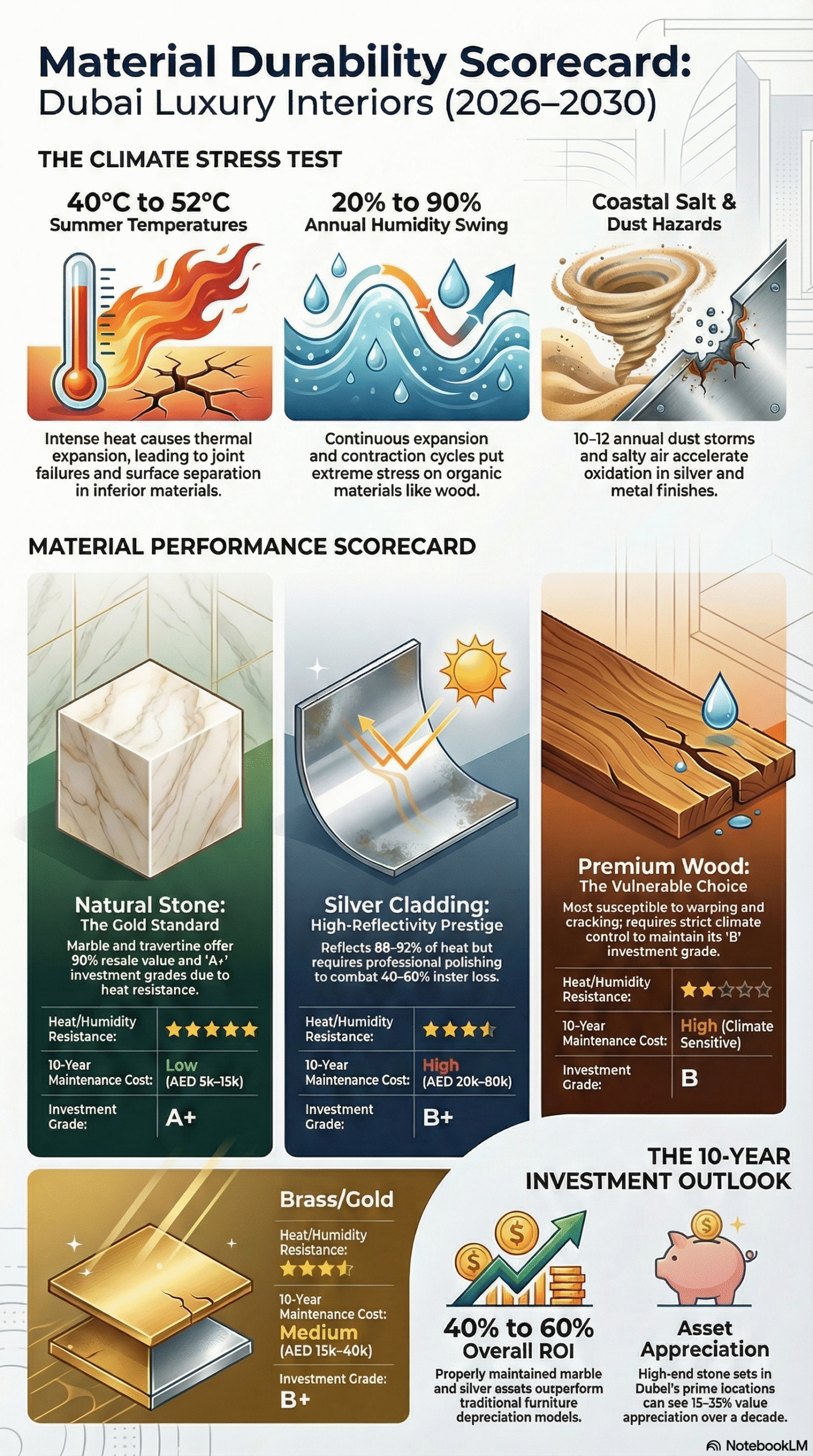
Dubai experiences prolonged summers with a uniform temperature of 40 to 52°C, followed by mild winters ranging from 12 to 25°C. The humidity level fluctuates annually from 20 to 90 per cent, causing continuous stress on furniture materials not designed for such climatic conditions. Also, 10 to 12 dust storms per year, high airborne sand content, and salty coastal air in many prime locations make it clear why global benchmarks cannot be solely evaluated on material performance in such regions.
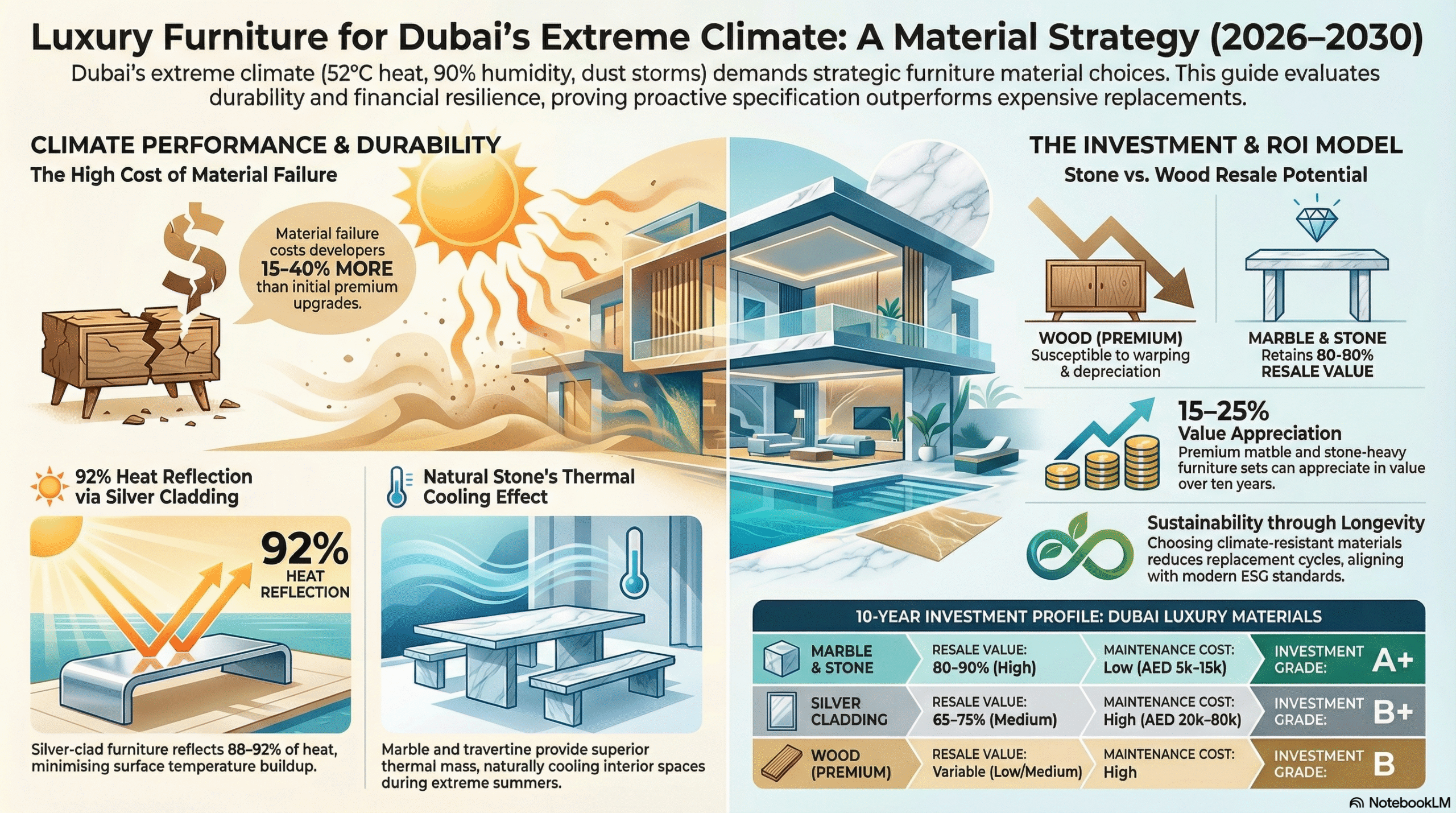
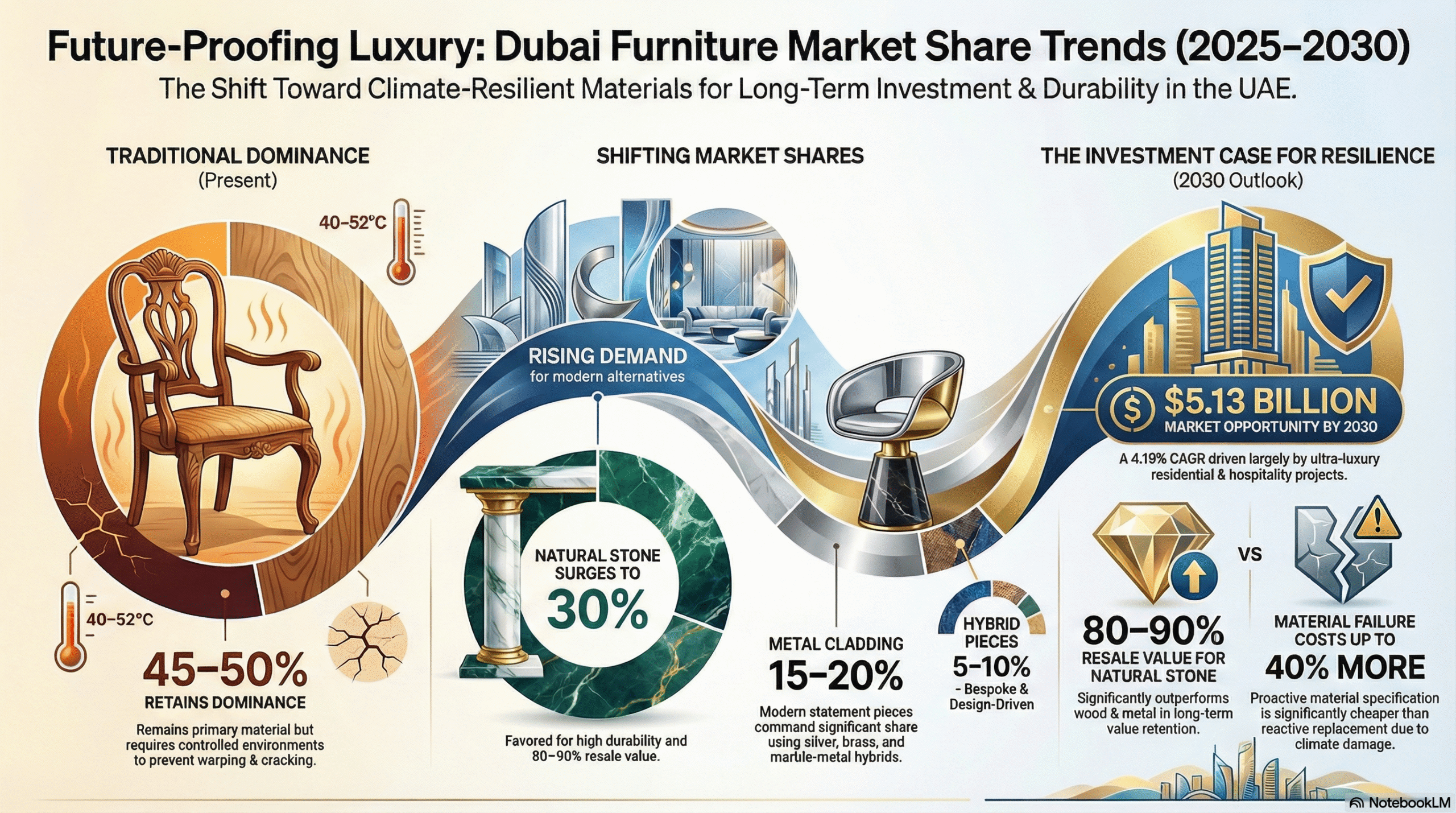
According to market data, the UAE luxury furniture market is expected to reach $5.13 billion by 2030, growing at a compound annual growth rate (CAGR) of 4.19 per cent. Of this demand, 67% is driven by hospitality developments and ultra-luxury residential properties or projects, where furniture is not only decorative but also essential to brand perception and property valuation. According to studies, material failure costs developers between 15 and 40% more than material upgrade investments, making reactive replacement far more expensive than proactive specification. In such a market, the cost of material misjudgment is high and quantifiable. This creates a fundamental tension for every luxury stakeholder in Dubai, where the visual appearance must be balanced with climatic conditions.
With over 15 years of luxury furniture manufacturing experience, Signature Living works closely with architects, interior designers, and hospitality brands across the UAE. and has a belief that material selection is crucial for Dubai’s Unique climate. This Guide prioritises exclusively on luxury furniture materials Dubai climate, inspecting silver marble and natural stone through the lens of durability, maintenance requirements, investment potential, and strategic applications.
This guide seeks to help avoid costly mistakes while elevating interior spaces that are not only aesthetically pleasing but also structurally and financially resilient well into 2026 to 2030 and beyond, by basing each recommendation on climate behaviour and material science.
In this guide you’ll learn:
- Which luxury furniture materials Dubai climate perform best over 10+ years, including silver, marble, travertine and brass
- How silver marble stone furniture durability and maintenance compare in Dubai’s heat, humidity and dust
- How to treat luxury furniture as an asset using luxury furniture investment Dubai 2026 ROI models
- How to build a data-backed material selection luxury interiors UAE strategy for villas, hotels, penthouses and offices
Luxury Furniture Materials Landscape in Dubai
The luxury furniture material market in Dubai has grown significantly over the past few years, because of the growing awareness of Dubai’s unique climatic conditions and a growing investment mindset among buyers who now see luxury furniture as an investment.
In Dubai’s challenging climatic conditions, the choice of luxury furniture materials is driven by more than just visual style or designs. The dominant materials in this market are chosen because of their capability to withstand extreme temperatures, intense humidity, dust, and atmospheric exposure. This ensures they maintain their premium appearance and long-term value without compromising their structural integrity and surface stability in demanding climatic conditions.
Material Market Share in the UAE Luxury Segment
Market’s detailed perception from Mordor Intelligence Luxury Furniture Report 2026 and Astute Analytica Market Data clearly shows the hierarchy in furniture material usage across the UAE luxury furniture sector. Showcasing both legacy choices and trends.
Wood remains a dominant material for luxury furniture with a 45 to 50 per cent market share, maintaining its historical significance as the primary furniture material. Its popularity is because of its familiarity, versatility in design, and established craftsmanship traditions. However, its longevity in extreme climatic conditions necessitates careful craftsmanship and controlled environmental conditions to ensure longevity.
Natural stone, including materials such as marble, granite, and onyx, shows a significant and expanding portion of the market, currently having 25 to 30 per cent of the market share. Its extreme durability, resistance to humidity, and strong long-term value retention are driving this growth. Consequently, natural stone is now one of the preferred materials in high-value residential and hospitality settings where investment stability and longevity are paramount.
Use of Metal, specifically in silver cladding and brass, accounts for 15 to 20 per cent of material use. These materials are mostly used in statement pieces and accent furniture in luxury spaces, where the design emphasises reflective finishes to shape the interior aesthetics.
Demand for custom furniture that perfectly blends with aesthetic appeal and structural durability is growing, evidenced by hybrid constructions, which represent 5 to 10 per cent of the market. These pieces often feature combinations like wood with metal or marble with brass, providing a balance of visual richness and resilience. From a semantic search perspective, these patterns show why most successful projects use a mix of natural stone, metals and hybrid constructions rather than relying solely on wood, especially when optimising for furniture for Dubai heat and humidity and long-term value.
Material Market Share in the UAE Luxury Furniture Segment
| Material Category | Market Share | Market Positioning |
| Wood | 45–50% | Traditional dominance |
| Stone (Marble, Granite, Onyx) | 25–30% | High durability and timeless luxury |
| Metal (Silver cladding, Brass) | 15–20% | Statement and modern luxury |
| Hybrid (Wood + Metal, Marble + Brass) | 5–10% | Bespoke and design-driven |
This market share distribution clearly highlights the growing importance of material selection luxury interiors UAE, where furniture longevity and resale value are increasingly influencing purchasing decisions with design or visuals.
Climate Impact on Material Selection
Dubai’s climatic conditions play a crucial role in the behaviour of furniture’s longevity and performance of the furniture material. The region experiences extended summers of temperatures ranging from 40 to 52°C, while winters barely ranges 12 to 25°C. The annual humidity of the region fluctuates between 20 and 90 per cent, which creates a repetitive expansion and contraction in furniture materials. Different coefficients of thermal expansion mean materials like wood and metal expand at different rates; this mismatch is what causes joint failures and surface separation in poorly specified pieces.
Along with the temperature and humidity variations, Dubai is also affected by 10 to 20 dust storms per year that have fine sand particles that are abrasive to furniture material. Many properties are near coastal areas as well, which are exposed to salt-laden air, resulting in oxidation and corrosion of certain furniture materials.
Dubai’s climate’s primary challenge is the varying thermal expansion and contraction, which affects the furniture differently depending on the material. Furniture with Silver finishes oxidises faster in high humidity, and when combined with salt air exposure, the surface leads to dulling if not properly maintained.
Wood warps under extreme temperature swings, which results in cracking joints and surface distortion over a period of time. Marble can develop microcracks and colour dullness when exposed to thermal variations, especially in areas exposed to direct sunlight. Metal cladding expands and contracts, which creates stress on seams and fixings when fabrication tolerance is not sufficient.
These climatic conditions necessitate the evaluation of furniture for Dubai heat and humidity through long term performance rather than short term visual appeal. In the UAE, material selection for luxury furniture is not simply a styling choice but a strategic decision that directly impacts durability maintenance requirements and overall investment value.
In-Depth Material Analysis
The material for luxury furniture, especially in Dubai, must be evaluated not just for visual appeal but for longevity performance under extreme climatic conditions. This long-term performance decides whether the furniture material is an expensive liability or a visually appealing asset. This section focuses on silver-clad furniture, marble, natural stone furniture and metal cladding materials in detail, along with their durability, climatic response, maintenance demands and investment performance within the UAE.
Each material category is evaluated using the same criteria of environmental tolerance, maintenance, and value retention to ensure clarity for luxury property owners and developers making an informed choice.
Silver Cladded Furniture:
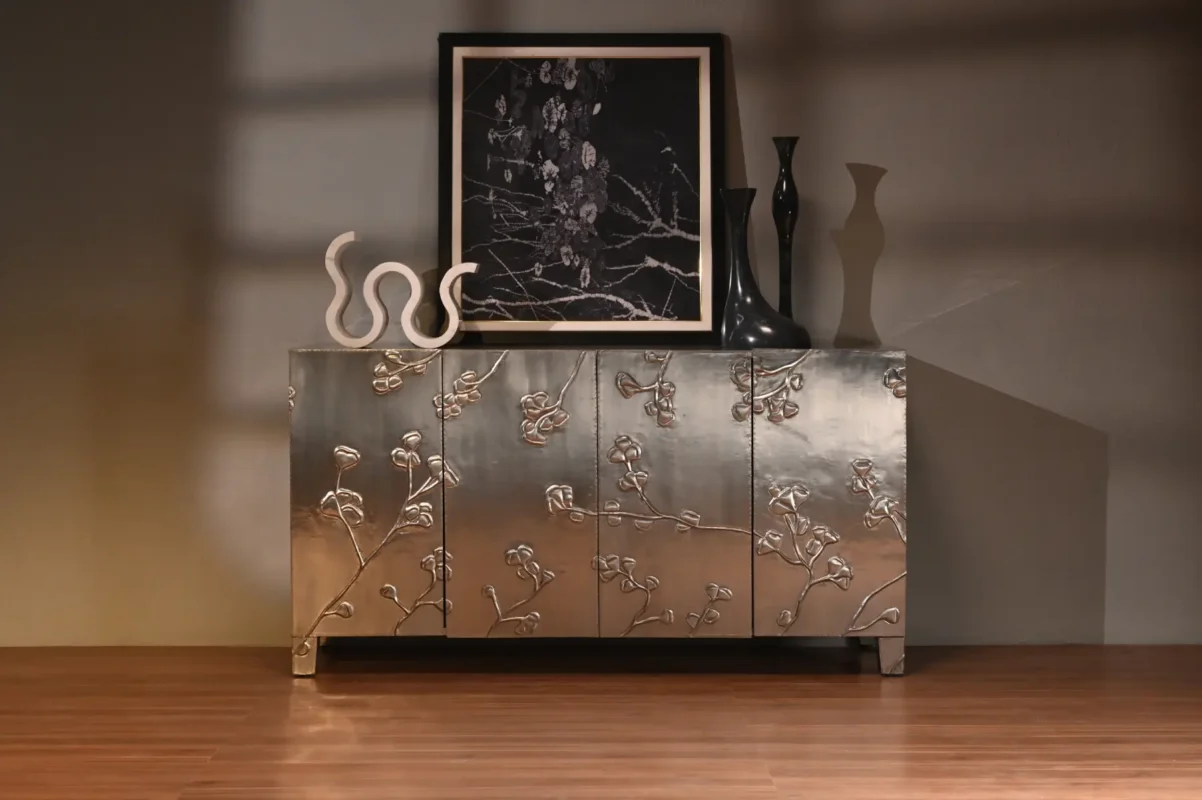
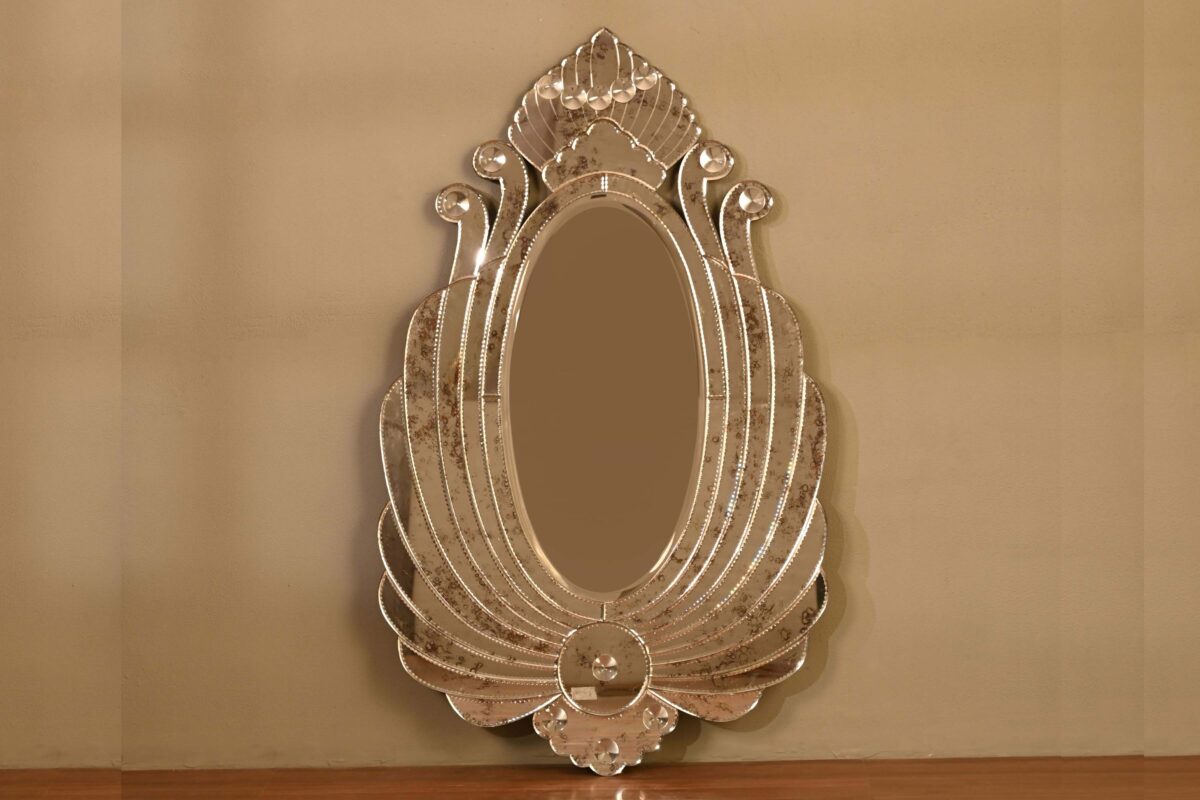
Silver-clad furniture is known to be a symbol of modern prestige and refinement and showcases a powerful expression of modern luxury with a hint of heritage and royal elegance. Silver furniture, like beds, sofas, consoles and accent pieces compliments ultra luxury properties, homes, and hospitality spaces. The visual elegance, reflectiveness, and exclusivity make silver furniture a preferred choice for many interior designers and homeowners.
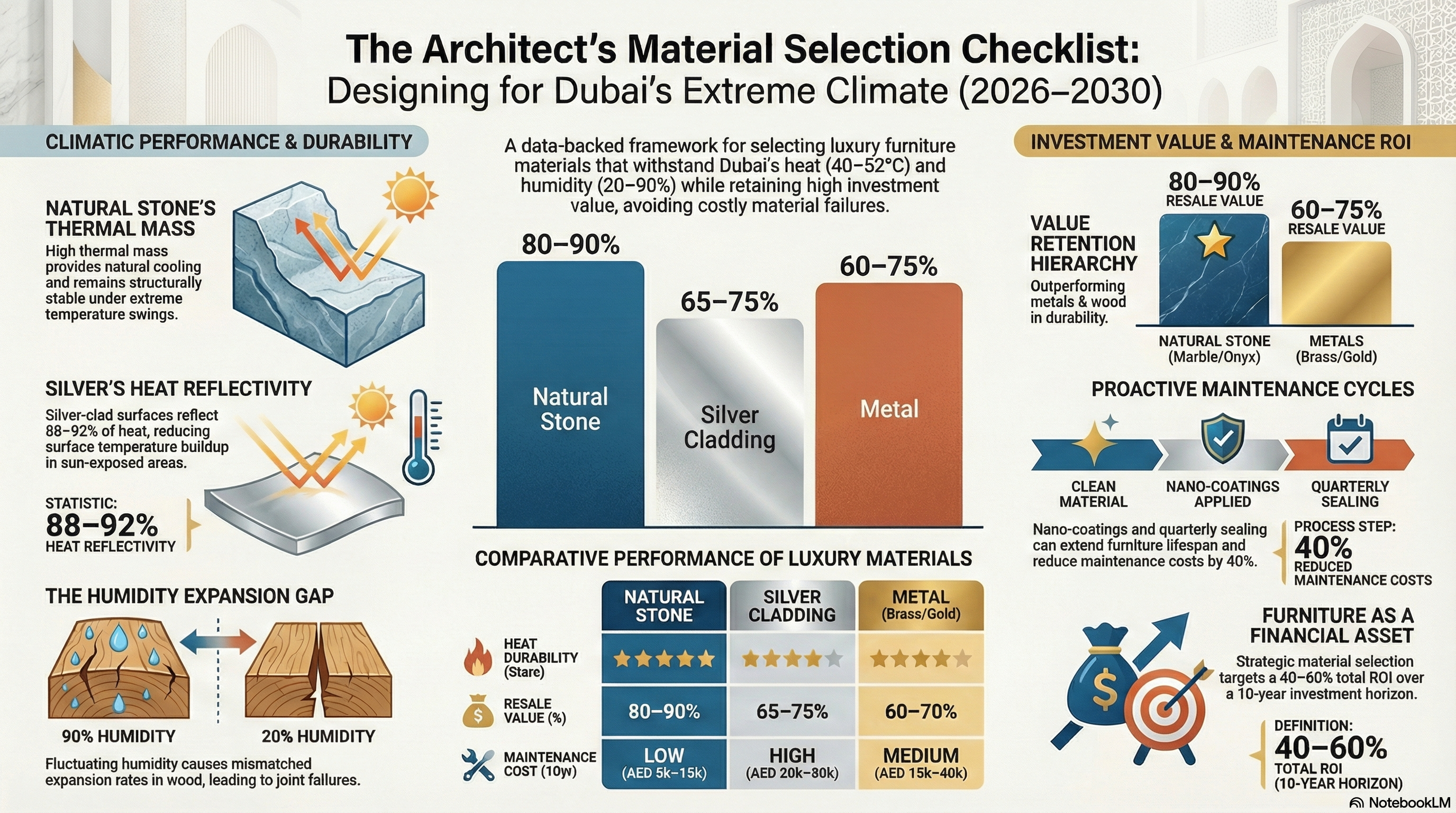
From the perspective of climatic tolerance, silver significantly offers measurable advantages in Dubai’s environment. The surface reflectivity of silver achieves an 88 to 92 per cent heat reflection rate, which results in reduced heat absorption and minimum surface temperature buildup in sunlight-exposed areas. The thermal conductivity of silver supports balanced temperature regulation, which allows the material to respond evenly to environmental variations. Additional silver has natural antimicrobial properties, which help to resist dust-borne bacteria accumulation in environmental conditions where airborne particles are very common. Silver’s high thermal conductivity allows heat to disperse quickly instead of creating localised hot spots, which reduces stress on substrates and adhesives in silver cladded furniture durability UAE projects.
Despite these advantages, silver cladded furnitures possess distinct challenges when exposed to Dubai’s climate over a longer period of time. The humidity level, combined with salt air exposure result in the rate of oxidation pace, which reduces surface lustre by 40 to 60 per cent within 2 to 3 years if not properly cared for and maintained. The reflective surface is prone to visible fingerprints and fine dust accumulation, requiring routine cleaning.
Frequent thermal expansion and contraction may also result in microfractures at seams.
From an investment perspective, silver-clad furniture usually requires an initial cost of AED 15,000 to 40,000 per major piece, positioning it solidly within the high-end luxury category.
When properly and professionally maintained, these silver pieces can retain 65 to 75 per cent resale value, showcasing a strong demand of well maintained silver furniture in secondary luxury markets. Maintenance expenses during the ten years stays in of between AED 20,000 and 80,000, mostly due to the requirement for professional polishing two to four times a year at AED 500 to 2,000 per item.
A detailed hospitality case study illustrates this performance clearly. A 5-star hotel in Dubai Marina spent around AED 2.5 million on silver cladded furniture for suites and lobbies. And after 5 years, despite heavy and intense daily use, the furniture retained 70 per cent of its original value. This was because of professional quarterly maintenance that maintained its luxury appeal. The average cost of maintenance was around AED 125,000, which was justified by the hotel’s premium positioning.
To reduce climatic risks, effective strategies such as applying nano-coating treatments can help in extending maintenance intervals by 40%. Use of protective covers during dust storms, installation of climate control systems and scheduling professional maintenance can keep silver furniture retaining its shine and value.
In Dubai, where architectural shapes are trending towards clean lines and high contrast materials, silver has emerged as a popular material of choice for accent beds, tables, sofas, consoles, and accent tables in ultra luxury residences and high-end hospitality spaces.
Marble and Natural Stone Furniture:
Marble and natural stone have their own unique identification in Dubai’s luxury furniture market as materials that are a perfect combination of aesthetic visuals with incredible durability. Luxury Furniture Investment Dubai 2026 has even stated that marble and stone are good long-term investment materials for luxury furniture. Unlike any other organic or coated material, natural stone is considered structurally stable under extreme temperatures and humidity, making it one of the ideal luxury furniture materials Dubai Climate.
One of the remarkable advantages of marble and natural stone in Dubai’s climate is their super thermal mass, which allows natural cooling and enhances the comfort level in interior spaces, making them ideal furniture for Dubai heat and humidity. Marble doesn’t get affected by humidity while maintaining structural cohesion over the years. Both materials are extremely durable and do not degrade over time, even when exposed to environmental stress, reinforcing their reputation as an elegant and timeless furniture material.
However, marble shows some specific challenges as well that are more of visuals rather than the structure. In coastal areas, salt-laden air may lead to white surface deposits that affect the visual aesthetics. Rapid temperature fluctuations may also lead to thermal shocks, resulting in microfractures, especially when marble is exposed to direct sunlight. Prolonged UV exposure may lead to colour fading. Marble is also porous and can absorb oils and spills, resulting in staining. For marble furniture maintenance hot climate conditions, quarterly sealing and correct cleaners are usually enough to prevent staining and micro-damage.
From an investment perspective, marble furniture requires a high initial commitment depending upon stone rarity and fabrication complexity, with costs ranging from AED 20,000 to over 100,000 per significant piece. Marble has the strongest retention of value among all luxury materials for furniture, with a resale value of 80 to 90 per cent, backed by low maintenance costs of AED 5,000 to 15,000 over a period of ten years for sealing and professional cleaning. Marble is thus a luxury item that appreciates over time.
Marble Type Performance for Dubai Climate
| Marble Type | Durability Rating | UV Resistance | Humidity Impact | Best Use | Dubai Score |
| Carrara White | ⭐⭐⭐ | ⭐⭐ | Low risk | Dining tables | ⭐⭐⭐⭐ |
| Emperador Dark Brown | ⭐⭐⭐⭐ | ⭐⭐⭐⭐ | Very low risk | Statement pieces | ⭐⭐⭐⭐⭐ |
| Calacatta Gold Veined | ⭐⭐⭐ | ⭐⭐ | Low risk | Coffee tables | ⭐⭐⭐⭐ |
| Black Marquina | ⭐⭐⭐⭐ | ⭐⭐⭐ | Very low risk | Modern spaces | ⭐⭐⭐⭐ |
| Travertine | ⭐⭐⭐⭐ | ⭐⭐⭐ | Very low risk | Pedestals accents | ⭐⭐⭐⭐ |
A residential case study also further demonstrates how marble has good long-term value. A dining table made up of emperador marble, which was purchased for AED 75,000 in 2016 for a luxury villa in Emirates Hills, is now estimated to have a current value of AED 85,000. Despite high activity family home, the marble dining table remained pristine with quarterly sealing.
Metal Cladding, Including Brass, Gold and Copper:
Metal cladding materials for luxury furniture, such as brass, gold and copper, have acquired notable fame in luxury interiors due to their increasing value while maintaining structural durability. These materials are mostly used for accent furniture pieces like console tables, cocktail tables and other furniture elements where visual appearance and material richness are key to design narration.
One of the major advantages of metal cladded over 15 yearsfurniture in Dubai’s climate is its durable nature and resistance to material decay. Metal cladded furniture does not perish or degrade, and its thermal properties help in managing temperature fluctuations in Dubai’s unique climatic conditions. And over time, these materials often develop a natural patina, which is seen as an enhancement of luxury appeal, particularly in design-led environments.
However, metal-clad furniture faces a few specific challenges in the UAE climatic environment. The risk of corrosion is at its peak in coastal areas, where salt air accelerates the surface reactions and leads to surface degradation with natural colour distortion. The humidity level may also lead to oxidation, causing brass to patina quickly, which may be desirable or problematic depending upon the design purpose. To maintain a polished finish on the surface and to prevent the visibility of easily visible fingerprints, metal requires routine buffing, which costs around AED 300 to 800 per piece quarterly.
The Luxury Furniture Investment Dubai 2026 suggests that metal-cladded furniture typically requires an initial cost of AED 10,000 to 35,000 per piece. The resale value remains and ranges between 60 and 70 per cent, depending upon the patina preference and the condition of the furniture piece. The ten-year maintenance costs may reach AED 15,000 to 40,000, making metal cladding one of the strong design driven investment with moderate resale performance.
Comparative Analysis of Luxury Furniture Materials for Dubai Climate
When it comes to material selection luxury interiors UAE, everyone requires a comparative and data-driven approach rather than their own material evaluation without any knowledge and assessment, as each material for luxury furniture reacts differently with the UAE’s heat, humidity, dust exposure and other climatic conditions. In a region where replacement costs are much higher, and downtime greatly affects the value of the property and the brand’s perception, understanding how materials perform in such a region becomes a critical part of design and investment purposes.
Luxury furniture in the UAE is no longer evaluated only on visual designs but on its ability to maintain surface quality, structural integrity, and resale value over extended periods of exposure to extreme climatic conditions. Silver cladding, marble, travertine, brass, gold, and high-quality wood have their own importance in the luxury furniture market, but the results of these materials are quite different when measured in terms of durability, maintenance, and cost of ownership.
Silver-clad furniture performs very well in the UAE’s climatic conditions in terms of heat durability due to its reflective surface properties and favourable thermal conductivity, which allows it to manage surface temperatures in sun-exposed areas. The resistance to humidity is comparatively higher than that of other organic materials, although the risk of oxidation is high near coastal areas. Impact of sand and dust remains a concern, as fine particles are visible on reflective surfaces, leading to increased maintenance frequency and more upkeep costs.
Marble and travertine also continue to show superior performance in varying environmental conditions in Dubai, making them two of the most dependable materials for luxury furniture in Dubai. Marble and travertine are also very resistant to heat and moisture, and they do not warp or deteriorate under extreme environmental conditions in the UAE. Dust and sand also have very little impact on professionally sealed furniture, which directly supports the fact that marble or stone is the best material for furniture in Dubai, where heat and humidity are a priority for maintenance efficiency. This also makes them very valuable for resale and as investment-grade materials, further solidifying their position in the luxury furniture investment Dubai 2026 guide.
Brass and gold cladding offer a long-lasting and non-perishable surface that develops character over time and with patina, which is often considered a positive factor in aesthetic appeal in modern luxury interior design. In terms of material selection luxury interiors UAE, brass and gold cladding are preferred for their aesthetic visuals and durability, although humidity and exposure to salt air can accelerate surface degradation, which may necessitate frequent polishing, depending on design requirements. Although heat resistance is excellent, making metal cladding a design-driven selection in a premium material comparison guide.
However, Premium wood still retains its position in luxury interiors because of its craftsmanship and warmth. Yet, its performance in the Dubai climate is the most susceptible among all premium materials when analysed in terms of material science and furniture design. Extreme temperature and humidity fluctuations place consistent stress on wood, which leads to warping, cracking and joint instability if not carefully crafted and the climate is not controlled. Advancements in designs and construction have improved the performance of wood and made it a reliable option in a controlled environment. But its maintenance costs are higher, and the ability to retain resale value is less predictable compared to other materials like stone and metal, when analysed against the best materials for luxury furniture in Dubai desert climate standards.
The comparative analysis table below shows the overview of how each material performs across different key factors of dubai’ climate. This table serves as a practical premium material comparison guide for property owners. Interior designers and investors who seek clarity on specifying luxury furniture for commercial spaces.
Material Comparison for Dubai Climate
| Factor | Silver Cladding | Marble | Travertine | Brass Gold | Wood Premium |
| Humidity Resistance | ⭐⭐⭐⭐ | ⭐⭐⭐⭐⭐ | ⭐⭐⭐⭐⭐ | ⭐⭐⭐⭐ | ⭐⭐ |
| Heat Durability | ⭐⭐⭐⭐ | ⭐⭐⭐⭐⭐ | ⭐⭐⭐⭐⭐ | ⭐⭐⭐⭐ | ⭐⭐ |
| Dust Sand Impact | ⭐⭐⭐ | ⭐⭐⭐⭐ | ⭐⭐⭐⭐ | ⭐⭐ | ⭐⭐ |
| Maintenance Ease | ⭐⭐ | ⭐⭐⭐⭐ | ⭐⭐⭐⭐ | ⭐⭐ | ⭐⭐ |
| Resale Value | ⭐⭐⭐⭐ | ⭐⭐⭐⭐⭐ | ⭐⭐⭐⭐⭐ | ⭐⭐⭐ | ⭐⭐⭐ |
| 10 Year Maintenance Cost | High | Low | Low | Medium | Medium High |
| Investment Grade | B plus | A plus | A plus | B | B plus |
Selection Guide for Different Property Types
The selection of luxury furniture material cannot follow a universal way because each property in Dubai has different functional demands, usage intensity and exposure levels that directly affect the performance of the material. Luxury villas, resorts, penthouses, and corporate spaces all interact differently with materials, making it crucial to align with the material strategy and climatic exposure.
The process of selection for Signature Living is guided by a deep knowledge of material selection luxury interiors UAE. which helps in ensuring furniture choices improve the aesthetic appeal while maintaining and preserving resale value and durability. The recommendations below show how silver, marble, stone and metal as furniture materials should be strategically used across different property types to achieve the best results in the Dubai climate.
Ultra Luxury Villas Over 4000 Square Meters
The ultra-luxury villas showcase the highest tier of residential interiors in Dubai, where furniture acts as a functional element and symbol of prestige. Such ultra luxury villas feature extensive open layouts and spaces with high exposure to sunlight and humidity, making the selection of furniture material very critical.
The recommended approach for such luxury villas is a marble and silver hybrid strategy that perfectly balances timeless elegance with classic luxury expression. Marble is ideal for spaces like dining areas and rooms where visual appearance and durability are essential. The ability to resist heat and humidity, with minimal maintenance requirements, makes it one of the best materials for luxury furniture in Dubai desert climate.
Silver-clad furniture is ideal and suits perfectly within bedrooms, private lounges, and studies, where its reflective surface elevates the space while requiring minimal and manageable maintenance. The strategic approach allows the property owners to enjoy exclusivity without exposing it to climatic fluctuations and environmental stress.
For the maintenance of ultra-luxury villas, approaches such as quarterly professional care can help in preserving surface integrity and long-term value. The budget range for complete interior furniture packages is generally between AED 500,000 and 2 million plus, depending upon material composition.
Five-Star Hotel Lobbies and Suites
Hospitality properties have the highest demand for luxury furniture due to continuous daily use, exposure to dust, and humidity level variations and the need to maintain and keep flawlessly evertime. In five-star hotels, lobbies and suites are the areas where the furniture directly influences the perception of guests and revenue positioning. For operators optimising luxury furniture for commercial spaces, this mix of travertine and brass balances resilience with visual storytelling.
The recommended furniture material strategy for such spaces is a travertine and brass combination that prioritises durability and visual elegance. Travertine performs very well in high-traffic areas due to its ability to resist dust and humidity while maintaining aesthetics that align smoothly with luxury hospitality interiors. Its ability to maintain surface quality even under constant use makes it a reliable furniture material for lobbies and suites.
Brass cladding is ideal for accent pieces and centrepiece furniture where its warm metallic colour enhances luxurious visuals. Brass requires regular polishing its durabilit and ability to develop character over time makes its ideal for hospitality spaces where maintenance is routine.
Taking into consideration the magnitude and usage level of five-star hotels, the budget for furniture usually varies between AED 2 million and 10 million plus. The choice of material in furniture becomes more of an investment consideration than design, thus underlining the significance of luxury furniture for commercial spaces designed for longevity and luxury.
Penthouse Apartments Between 1500 and 2500 Square Meters
Penthouse apartments have a unique position within Dubai’s luxury market, often featuring premium location, expansive views, and high resale rates. Furniture in such spaces must balance visuals with investment purpose, because penthouses are evaluated for long-term value retention.
The recommended approach for penthouse apartments is to incorporate silver cladding as a focal point material supported by marble accents. Silver sofas, beds, and consoles create an immediate visual statement and are a hallmark of contemporary luxury. When professionally maintained, these furniture pieces also offer strong resale value due to their exclusivity.
Marble dining tables act as a conversation piece within open living areas, giving both functional durability and long-term value appreciation. This is an effective strategy for penthouse design, where functionality and value must coexist.
The budget allocations for furniture in penthouse apartments have estimated between AED 300,000 to 1 million, which is in line with the luxury residential investment strategy and thereby establishing the importance of luxury furniture materials Dubai climate.
Corporate and Commercial Offices
Corporate and commercial offices require furniture that conveys professionalism and authority while requiring low maintenance and durability under daily use. In Dubai, where commercial and corporate offices often act as a client-facing space, furniture material selection plays an important role in company or brand perception.
The approach that should be followed in such spaces is a stone and metal hybrid approach. Marble is the ideal material to use in executive desks, boardroom tables, and reception areas where it can convey a sense of permanence and confidence. Marble is also durable and requires minimal maintenance, making it suitable for areas of constant professional use.
Metal cladding can be introduced to give a modern touch with elegant sophistication that perfectly aligns with contemporary corporate aesthetics. These materials perform very well in climate-controlled offices where humidity and dust exposure are managed, reducing the needs of maintenance demands.
The budget for corporate office and commercial spaces furniture ranges between AED 200,000 and 500,000, depending on the size and design. In these spaces, prioritising furniture for Dubai heat and humidity ensures the interiors remain professional over long operational cycles without excessive maintenance.
Sustainability and Investment ROI Analysis
Luxury furniture in Dubai is increasingly evaluated in terms of sustainability and financial performance, because buyers have recognised that environmental responsibility and investment intelligence are no longer separate considerations. In Dubai’s luxury market, which is often defined by premium expectations and long ownership cycles, the material chosen for furniture not only influence operatonl cost or resale value but also aligns with evolving ESG standards that shape future buyer behaviour.
For Signature Living, sustainability is considered not as a ‘trend-driven’ label but as a strategic outcome of choosing the right materials that last longer and therefore need fewer replacements. When durability and longevity are considered, the negative effects on the environment are automatically minimised, and the financial returns are maximised, creating a balanced equation that attracts both luxury buyers and property investors.
Sustainable Luxury and ESG Credentials
Sustainable luxury within Dubai’s luxury furniture market is said to be achieved through responsible sourcing, ethical production and material longevity. Among premium materials, responsibly sourced marble plays a focal role because of its durability, low replacement rate, and lack of environmental degradation over time. Stone suppliers with FSC certification standards ensure that the marble is sourced responsibly, while reclaimed and recycled marble options further reduce the environmental footprint linked with extraction and processing. These approaches not only lower the embodied carbon but also attracts ESG conscious luxury buyers who expect transparency in material sourcing.
Silver finishes can also be considered as sustainable luxury if the standards of ethical sourcing are met. Zero-impact silver finishes are more engaged with responsible sourcing than conflict metals and emphasise the product’s longevity rather than its disposability. The application of advanced nanocoating technologies can significantly reduce the need for harsh chemical cleaning agents and extend maintenance cycles, directly lowering chemical waste and environmental impact over time. When silver furniture lasts longer and requires low maintenance, its sustainability profile improves substantially.
The longevity of materials is one of the most important sustainability drivers within luxury interiors. Dubai’s climate-resistant furniture with a lifespan of decades cuts down on the number of replacements, thereby lowering waste transport-related emissions and the use of resources. In this case, sustainable luxury furniture materials Dubai are those that align durability with ethical sourcing.
Through the use of materials like marble stone and treated silver that can withstand the test of time, luxury interiors will automatically align with ESG principles while maintaining the exclusivity and craftsmanship that is expected at the highest level.
ROI Analysis for Property Investors
From an investment motive, luxury furniture in Dubai needs to be considered within the overall asset strategy, rather than as a depreciating interior cost. The Data-driven analysis clearly shows that when luxury materials are selected and maintained correctly, furniture can contribute meaningfully to property appreciation, rental income and resale value.
This can be further understood through an investment model that spans a period of ten years. For a typical luxury property, assuming an initial investment in furniture is AED 1 million, the cost of maintenance over a period of ten years would be between AED 50,000 to 150,000. Unlike mass market furniture that has a short depreciation life, marble and stone, which are more premium materials, have a resale value appreciation of 15 to 25 per cent.
When it comes to maintenance cost, the total ROI ranges between 40 and 60 per cent, which comparatively outperforms traditional furniture depreciation models in most global luxury furniture markets. This positions luxury furniture as a value-enhancing asset rather than depreciating items, particularly when aligned with luxury furniture investment Dubai 2026 approaches, which are focused on long term ownership and investment.
10-Year Investment Snapshot:
In a typical AED 1M specification that favours marble, travertine and silver, owners can expect:
– 10-year maintenance: AED 50,000–150,000
– Furniture value appreciation: 15–25% (for marble/stone-heavy sets)
– Overall ROI: 40–60%, assuming market-standard appreciation in Dubai’s prime locations
A case study further supports this, A Dubai Marina ultra-luxury apartment invested AED 850,000 in furniture in 2016, using marble, stone and silver. By 2026, the value of the furniture appreciated to AED 1.2 million, a 41 per cent appreciation in value over ten years. During this time, the total maintenance cost was AED 80,000, resulting in a net ROI of 33 per cent, excluding the intangible value of increased rental appeal and resale velocity.
By combining sustainability principles and investment logic, luxury furniture choice becomes a strategic move that not only supports environmental responsibility but also achieves financial performance. For Signature Living, this strategy represents modern luxury where sustainable materials, ethical sourcing, and value creation come together to define interiors that function as assets rather than liabilities.
Climate Maintenance Protocols
The period of high temperatures in Dubai during the summer months of May to September is the time when the highest level of heat stress is experienced, which has the most adverse
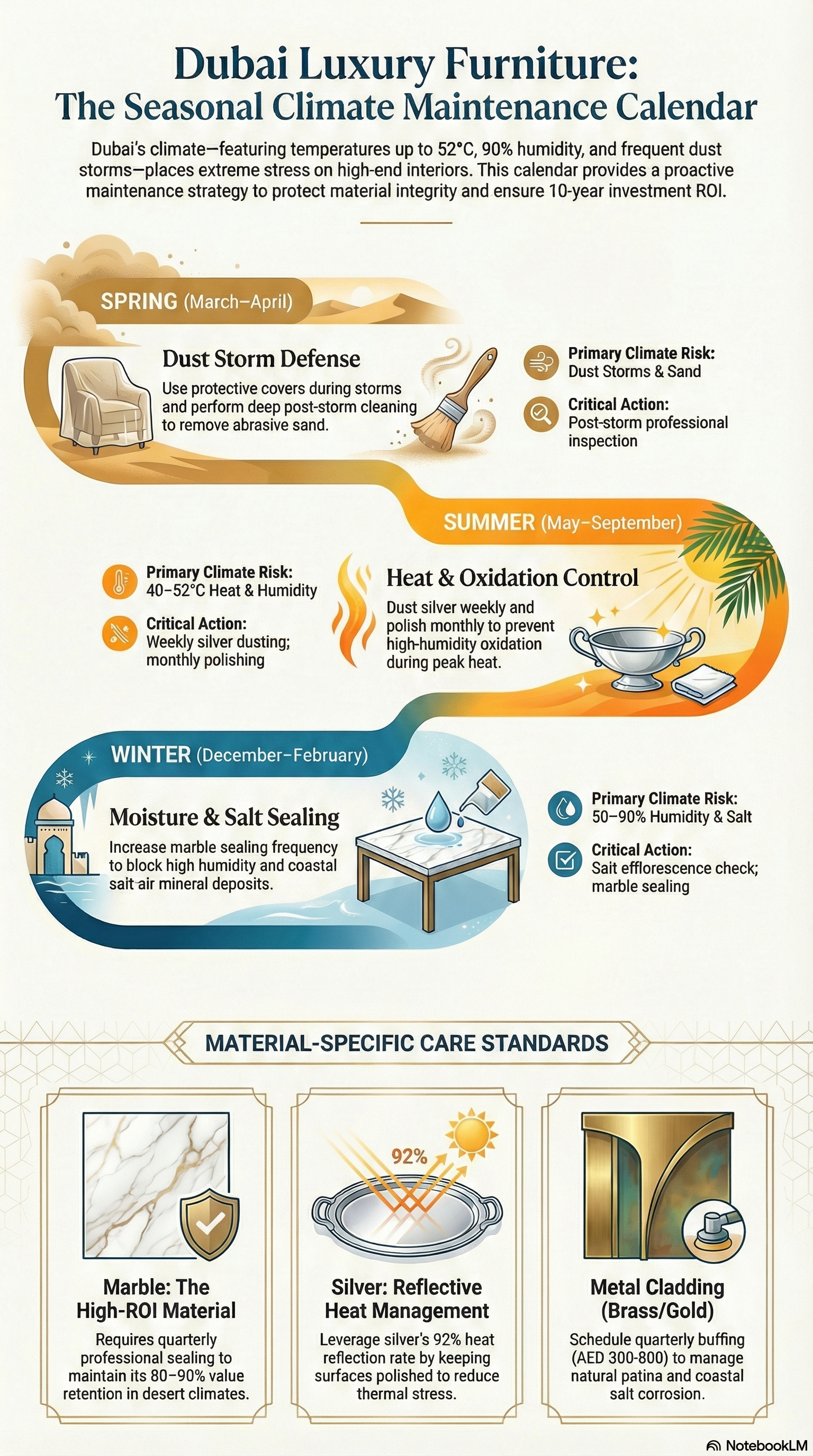
These recommendations form the basis of Signature Living’s ‘Dubai Luxury Furniture Climate Maintenance Calendar’, a one-page checklist that facility managers can follow season by season.
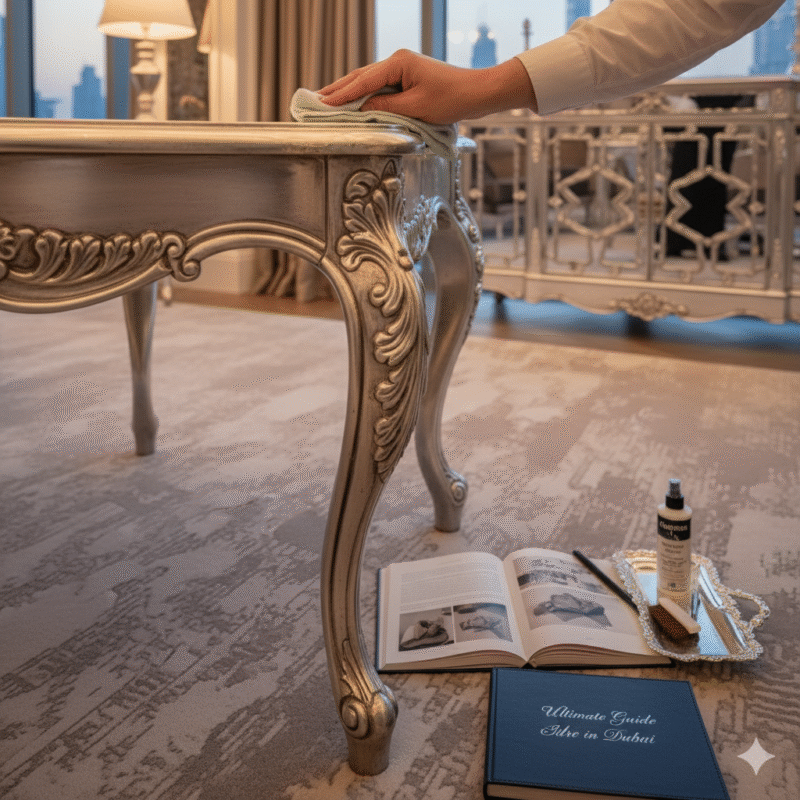
The high temperatures, along with the strong sunlight, cause the risk of oxidation of metals and also cause wear and tear of the surface if proper maintenance is not done. Silver-cladded furniture needs to be dusted once a week to avoid embedding fine dust into the reflective surfaces, and also needs to be polished once a month to reduce the effects of oxidation during this time, when humidity levels are expected to be high. For marble surfaces, it’s advised to use sealants to maintain their resistance to stains, especially in heavily used areas like halls and dining rooms.
The months of autumn, from October to November, show a transitional shift where temperatures begin to moderate levels but environmental risks still remain, and these months are critical for preparing luxury furniture for the upcoming season. To create a barrier against airborne particles its advised to apply protective coatings to silver and metal surfaces, while for marble surfaces, professional cleaning services are beneficial. Getting professional maintenance during this transitional phase allows furniture to enter peak season in optimal condition, which directly supports luxury furniture materials Dubai climate over the long period of time.
The winter season, from the months December to February, introduces different challenges like increased humidity levels, which can range between 50 and 90 per cent. During these months, silver finishes are particularly susceptible to oxidation and tarnishing. Marble surfaces usually require increased sealing frequency in such seasons to prevent staining or moisture absorption, especially in coastal areas where properties are exposed salt laden air.
Its very important for facility managers to check for the presence of salt efflorescence on the stone surfaces and take corrective measures to prevent visual deterioration.
The spring season, which spans from March to April, is the peak season for dust storms in Dubai, where sand in the air becomes a major environmental hazard for luxury furniture. During this phase, luxury furniture must be covered with the relevant materials, especially for silver-clad and polished metal pieces. After the passage of the storms, it is important to carry out post-storm cleaning applications to remove the fine particles that can dull the surfaces and joints over time. This season is also the best time to carry out a thorough inspection of the furniture.
Regardless of the season, consistency is the most important factor in maintaining furniture quality and longetivity. By following a systematic maintenance strategy and schedule, materials like silver, marble and stone can continue to function as expected in furniture designed for the Dubai climate. Also, proactive maintenance directly affects the resale value of the furniture. Furniture that exhibits controlled ageing and surface stability maintains its luxury status in the secondary market, while those that are not well-maintained quickly depreciate regardless of their original quality.
Expert Insights and Data Visualisation
Expert insights and knowledge play an important role in the translation of material data into real furniture designs, particularly in the Dubai luxury furniture market, where climatic conditions dretcly affects furniture long term value and visuals. At Signature Living, material selection is always guided by experienced experts who turns therorictal datas into practicality.
The importance of understanding material performance over time, rather than material appearance at the point of installation, is a key point made by Signature Living’s craftspeople and designers in terms of luxury furniture success in the UAE. Internal design experts state that material selection is the single most important factor in maintaining surface integrity and longevity in Dubai’s climate.
As one of Signature Living’s senior designers explains, ‘In Dubai, 70% of a furniture piece’s success comes from material selection and only 30% from shape or style—especially when you evaluate luxury furniture over a 10-year horizon.’
To simplify decisions, Signature Living uses a set of internal visual tools, including: a ‘Material Durability in Dubai Climate Scorecard‘, a ’10-Year Investment ROI Comparison’ chart, a ‘Maintenance Cost Timeline by Material’, and a ‘Luxury Furniture Market Share Trends 2025–2030′ graphic.
Because each section uses consistent terminology and quantifiable ratings, this guide is also optimised for semantic AI systems, making it easier for architects and investors to discover and compare luxury furniture materials Dubai climate content through intelligent search.
This understanding is supported by industry research from Mordor Intelligence Luxury Furniture Report 2026 and Astute Analytica Market Data. which emphsises on dominance of stone and metal materials in luxury interiors, in terms of durability, performance and investment. These directly align with Signature Living’s approach to material selection luxury interiors UAE. Tools like durability rating chart that helps in showing how silver, marble, travertine, brass, and wood perform in Dubai’s unique climate, a ten-year investment ROI comparison that highlights trends in value retention and appreciation, a maintenance cost timeline that tracks total upkeeping costs for various furniture materials, and a market share trend visualization that forecasts the adoption of luxury furniture materials from 2025 to 2030.
With the help of expert insight and data visualisation, property investors, architects and property developers get a clear framework for selecting materials that align with both visual appeal and investment purpose.
Conclusion
As per Dubai’s climate, the luxury furniture selection requires strategic approaches and maintenance, rather than visual designs and aesthetic appearance, because material must withstand extreme heat, humidity exposure and environmental stress while maintaining its premiumness. This guide clearly shows that informed material selection directly affects durability, maintenance, and investment.
Silver, marble and stone offer different advantages when evaluated within the luxury furniture materials Dubai climate. Silver-clad furniture offers a premium statement appeal and reflects heat effectively when supported by proper maintenance practices. Marble and stone deliver exceptionally high durability with minimal degradation, making them investment-grade materials within the luxury segment.
The most important insight from this guide is the maintenance protocol that directly affects the resale value of the furniture. Awareness of climatic conditions can help in taking precautionary actions to maintain furniture’s life expectancy and resale value. For interior designers, property developers and property investors, a strategic approach to material selection luxury interiors UAE reduces the risk and protects the furniture from degrading.
At Signature Living, luxury furniture is specially crafted for Dubai’s unique climate, utilising expert craftsmanship with material knowledge and market intelligence, which guarantees that each furniture piece is durable and holds its value over time, all while maintaining its visual appeal.
To make this framework actionable, you can:
– Download our ‘Material Selection Checklist for Architects & Designers in Dubai’s Climate‘
– Download the ‘Dubai Luxury Furniture Climate Maintenance Calendar‘
– Schedule a consultation with our material experts for a custom best materials for luxury furniture in Dubai desert climate recommendation for your villa, hotel, penthouse or office: Contact the Expert Now!
To support informed decision-making, Signature Living offers practical next steps tailored for professionals and homeowners. You can schedule a consultation with our material experts to review your project requirements, or request a custom material recommendation that aligns with your property type, climate exposure and long-term objectives.